
Chemistry by Rob Lewis and Wynne Evans
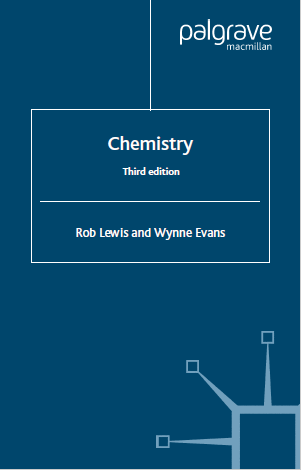
Summary of Chemistry by Rob Lewis and Wynne Evans
Chemistry by Rob Lewis and Wynne Evans – Third edition
Authors:
Rob Lewis
Wynne Evans
Table of Contents
Periodic Table
Preface xi
To the Student: How to Use this Book
- Acknowledgments
1 Number, Units, and Measurement
2 Elements, Compounds, and Reactions
3 Inside the Atom
4 Bonding Between Atoms
5 More about Bonding
6 Reactions of Ions in Solution
7 Oxidation and Reduction
8 The Mole
9 Calculating Concentrations
10 Gases, Liquids, and Solids
11 Solutions and Solubility
12 Chemical Families
13 Energy Changes in Chemical Reactions
14 Speed of Chemical Reactions
15 Dynamic Chemical Equilibria
16 Acid-Base Equilibria
17 Organic Chemistry: Hydrocarbons
18 Common Classes of Organic Compounds
19 Separating Mixtures
20 Light and Spectroscopy
21 Nuclear and Radiochemistry
22 Environmental Chemistry
23 Forensic Chemistry
To the Student: How to Use this Book
- This book is designed so that you can work with a minimum of help.
- It has a glossary of key definitions.
- Use the index to cross-reference other key terms and ideas.
- Obtain advice on the topics (and within units, the sections) which are relevant to your studies at this stage. If you possess a sound knowledge of GCSE chemistry, you will find that many of Units 2, 4, and 6 are already known to you.
- Do not move on to a new topic until you are happy with the previous one.
- There are exercises embedded in the text. Make a serious effort to answer these before carrying on. Check your answers with those at the end of the book.
- The boxes provide additional material (including some applications) but are not essential to the main body of the text and may be returned after you have mastered the rest of the chapter.
- to the case studies. Important extension material is indicated by an in the text. Concentrate on the basics in the book first before worrying about the
- Appendices!
Pages: 479. Please read Disclaimer.
You may also like “Comprehensive Chemistry Jee Advanced K.L Kapoor (2019)”.
Kindly Like, Follow and Share our social media pages so that maximum people can get the benefit from this public service!
Facebook Instagram LinkedIn Twitter Pinterest
Happy reading!