
Comprehensive Coordination Chemistry II From Biology to Nanotechnology by Jon A. McCleverty Volum 5
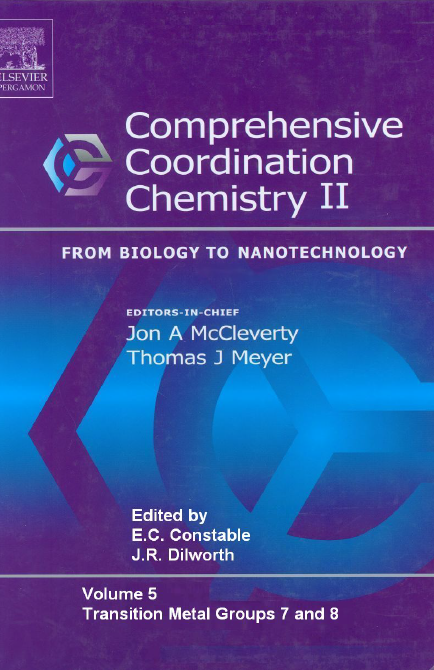
Summary of Comprehensive Coordination Chemistry II From Biology to Nanotechnology by Jon A. McCleverty Volum 5
Volume 5
Transition Metal Groups 7 and 8
Authors of: Comprehensive Coordination Chemistry II From Biology to Nanotechnology by Jon A. McCleverty Volum 5
Jon A. McCleverty
E.C. Constable
J.R. Dilworth
Table of Contents in Comprehensive Coordination Chemistry II From Biology to Nanotechnology by Jon A. McCleverty Volum 5
5.1.1 INTRODUCTION
5.1.2 OXIDATION STATE VII
5.1.2.1 Oxo and Halide Ligands
5.1.2.2 Nitrogen Donor Ligands
5.1.3 OXIDATION STATE VI
5.1.3.1 Oxo Ligands
5.1.3.2 Spectra
5.1.3.3 Nitrogen Donor Ligands
5.1.3.4 Other Complexes
5.1.4 OXIDATION STATE V
5.1.4.1 Oxo Ligands
5.1.4.2 Spectra
5.1.4.3 Oxygen Donor Ligands
5.1.4.4 Nitrogen Donor Ligands
5.1.4.5 Nitrogen and Oxygen Donor Ligands
5.1.4.6 Schiff Base Ligands
5.1.4.7 Cyano Ligands
5.1.5 MIXED OXIDATION STATES MnIV/MnIII
5.1.5.1 Introduction
5.1.5.2 Nitrogen and Oxygen Donor Ligands
5.1.5.2.1 Dinuclear complexes
5.1.5.2.2 Tetranuclear clusters
5.1.5.2.3 Hexanuclear cluster
5.1.5.2.4 Octanuclear cluster
5.1.5.2.5 Nonanuclear cluster
5.1.5.2.6 Decanuclear cluster
5.1.5.3 Oxygen DonorLigands
5.1.5.3.1 Dinuclear complexes
5.1.5.3.2 Tetranuclear clusters
5.1.5.3.3 Dodecanuclear clusters
5.1.5.3.4 Hexadecanuclear cluster
5.1.5.3.5 Higher nuclearity clusters
5.1.5.4 Nitrogen, Oxygen, and Halide Ligands
5.1.6 OXIDATION STATE III
5.1.6.1 Introduction
5.1.6.2 Oxygen DonorLigands
5.1.6.2.1 Carboxylates
5.1.6.2.2 Alkoxide and aryloxide ligands
5.1.6.2.3 Diketones and related ligands
5.1.6.2.4 Other oxygen ligands
5.1.6.3 SulfurDonorLigands
5.1.6.4 Nitrogen Donor Ligands
5.1.6.5 Mixed DonorPolydentate Ligands
5.1.6.5.1 Bidentate and tridentate
5.1.6.5.2 Tetradentate
5.1.6.5.3 Pentadentate
5.1.6.5.4 Hexadentate
5.1.7 COMPLEXES WITH MACROCYLIC LIGANDS
5.1.7.1 Oxidation States IV, V, and VI
5.1.7.1.1 Nitrogen donor macrocycles
5.1.7.1.2 Mixed donor macrocycles
5.1.7.2 Oxidation State III
5.1.7.2.1 Nitrogen donor macrocycles
5.1.7.2.2 Mixed donor macrocycles
5.1.7.3 Oxidation State II
5.1.7.3.1 Nitrogen donor macrocycles
5.1.7.3.2 Phosphorus donor macrocycles
5.1.7.3.3 Oxygen donor macrocycles
5.1.7.3.4 Sulfur donor macrocycles
5.1.7.3.5 Mixed donor macrocycles
5.1.7.4 Oxidation State I
5.1.7.4.1 Nitrogen donor macrocycles
5.1.7.4.2 Phosphorus donor macrocycles
5.1.7.4.3 Sulfur donor macrocycles
5.1.8 BIOINORGANIC CHEMISTRY
5.1.8.1 Introduction
5.1.8.1.1 Manganese coordination spheres in proteins
5.1.8.1.2 Acquisition of Mn
5.1.8.2 Enzymes with MononuclearActive Sites
5.1.8.2.1 Manganese peroxidase
5.1.8.2.2 Superoxide dismutase
5.1.8.2.3 3-Deoxy-D-arabino-heptulosonate-7-phosphate synthetase
5.1.8.2.4 Inorganic pyrophosphatase
5.1.8.2.5 Oxalate decarboxylase
5.1.8.2.6 Oxalate oxidase
5.1.8.2.7 Isopentenyl diphosphate isomerase
5.1.8.2.8 2-C-methyl-D-erythritol 2,4-cyclodiphosphate synthase
5.1.8.3 Enzymes with BinuclearActive Sites
5.1.8.3.1 Aminopeptidases
5.1.8.3.2 Arginase
5.1.8.3.3 Proclavaminate amidino hydrolase
5.1.8.3.4 Catalase
5.1.8.3.5 Protein phosphatases
5.1.8.3.6 Phosphoglycerate mutase
5.1.8.3.7 Glutamine synthetase
5.1.8.3.8 Isomerases
5.1.8.3.9 Transferases
5.1.8.4 Enzymes with Trinuclear Active Sites
5.1.8.4.1 Bifunctional inositol monophosphatase/fructose 1,6-bisphosphatase
5.1.8.5 Enzymes with Tetranuclear Active Sites
5.1.8.5.1 The oxygen-evolving complex of photosystem II
5.1.9 REFERENCES
Comprising ten volumes, this comprehensive series delves into the multifaceted realm of coordination chemistry. The first two volumes explore the fundamentals, covering ligands, complexes, synthesis, purification, and structure, as well as physical methods, theoretical analysis, and case studies. Subsequent volumes delve into the coordination chemistry of s, p, and f metals, as well as specific transition metal groups, providing an in-depth understanding of their properties. Volumes 7 and 8 transition from molecular to nanoscale perspectives, examining synthesis, structure, and properties. Volume 8 specifically delves into bio-coordination chemistry, highlighting its unique aspects. The penultimate volume, 9, focuses on the practical applications of coordination chemistry, showcasing its relevance in various fields. The series concludes with Volume 10, which comprises indexes for easy reference. This extensive collection serves as a valuable resource for researchers, students, and professionals seeking a comprehensive exploration of coordination chemistry.
Pages: 849 Please read Disclaimer.You may also like to read “Inorganic Chemistry by Gary L. Miessler 5th Edition”.
Kindly Like, Follow and Share our social media pages so that maximum people can benefit from this public service!
Facebook Instagram LinkedIn Twitter Pinterest
Happy reading!